Conversation is one of the most ordinary parts of a school day, but it carries a great deal of relational work. It is how students find common ground, ask for help, include others, negotiate ideas, share interests and begin to understand people beyond their existing friendship groups.
For some students, starting and sustaining a conversation comes naturally. For others, the first few seconds can feel uncertain: What do I say? How do I join in? What if we have nothing in common? Treating conversation as a skill that can be prepared, practiced and strengthened gives schools another practical way to support connection and belonging without assuming every student begins with the same confidence or experience.
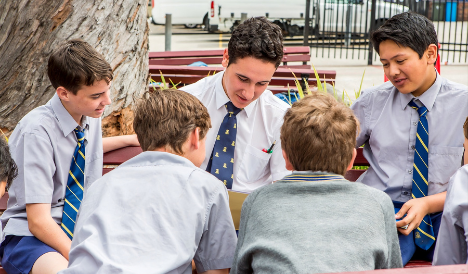
Peer Support’s Talk-And-Walk-A-Thon uses this principle in a simple way. Students walk with a peer using a guided conversation card, then change cards and talking partners at checkpoints. The structure creates a reason to begin, a topic to work with and repeated opportunities to practice the small behaviours that help a conversation feel reciprocal and respectful.
Give students a clear starting point
Open-ended prompts can remove some of the pressure of deciding what to say first. The most useful prompts are broad enough for different students to answer in their own way, while still being specific enough to get a conversation moving.
A primary prompt might ask, “What’s one thing you are really looking forward to?” A secondary prompt might ask, “What topic could you talk about for hours?” Neither requires a student to disclose anything deeply personal, but each creates an opening for a follow-up question and a chance to discover a shared interest or a different perspective.
Teachers can use the same approach in everyday classroom routines: a prompt at the beginning of collaborative work, a paired check-in after a break, or a short discussion question before students move into a new group. The aim is not to script students’ interactions. It is to provide enough structure for the conversation to start.
Teach what keeping a conversation going looks like
Students may know that they are expected to “have a chat” or “work with someone new” without having a clear picture of the behaviours that make an interaction easier. Making those behaviours visible can help.
Before a structured connection activity, teachers might briefly explore how to introduce yourself, ask a follow-up question, take turns, notice when the other person wants to speak and use non-verbal cues to show attention. A quick role-play can be useful because students can see the difference between a conversation that stops after one answer and one that develops through curiosity.
A useful classroom question is not only “What could you ask?” but also “What could you say next?”
This shifts attention from producing the perfect opening line to listening for something worth following up. If a student says they spent the weekend at a sports tournament, the next step might be to ask what they enjoyed, how the team went or how long they have played. The content matters less than the habit of listening and responding to what another person has actually said.
Put listening on equal footing with talking
Good conversation is not a competition to fill silence. Students benefit from recognising that listening is an active contribution: facing the speaker where appropriate, allowing them to finish, noticing the main idea and asking questions that show their response was heard.
It can be useful to ask students what being listened to feels like and what signals tell them another person is paying attention. Their answers can build a shared language for respectful interaction that is then reinforced across group work, peer-led activities and informal moments in the school day.
This also helps broaden the idea of social confidence. A student does not have to be the most talkative person in a group to contribute strongly to a conversation. Curiosity, attention and thoughtful follow-up questions are equally valuable.
Create opportunities beyond established friendship groups
Established friendships are important, but school also gives students opportunities to work and interact with people whose interests, experiences or perspectives may be different from their own. Those interactions do not always happen automatically.
Structured pairings or small-group rotations can make it easier for students to begin. In Talk-And-Walk-A-Thon, checkpoints provide a natural place to change cards and talking partners. In the classroom, the same principle can be used through rotating discussion partners, mixed-group reflection or short collaborative tasks that deliberately vary who works together.
The purpose is not to force friendship. It is to give students safe, ordinary opportunities to learn how to communicate with a wider range of peers and to discover that connection can begin with a relatively small interaction.
Prepare for different comfort levels
Not every student will approach a conversation with the same level of confidence, and that is an important part of planning. Some students may appreciate having a prompt in front of them, a clear time limit or a familiar structure. Others may be ready to move beyond the card and continue the conversation in their own direction.
Teachers can support participation by choosing prompts that suit the age and maturity of the group, explaining that students may stay with the card or use it as a starting point, and reminding students that respectful conversation includes allowing another person to pass on a question they do not want to answer.
If a student raises something concerning during a peer conversation, the activity should never make another student responsible for managing it. Students should know which adults they can speak to and teachers should follow the school’s usual support and safeguarding processes.
Make reflection part of the learning
After a conversation activity, a short debrief can help students notice what worked. Rather than asking only whether they enjoyed it, invite them to identify the skills they used: What helped you get started? What made it easier to keep talking? How could you tell the other person was listening? Did you learn anything unexpected about someone?
These questions help students see connection as something they can contribute to through everyday behaviour. They also give teachers useful information about which aspects of conversation may need more modelling or practice.
A practical way to put connection into action
Connection is often discussed as an outcome schools want students to experience. It can also be approached as something students actively build through repeated, everyday interactions.
Peer Support’s FREE Talk-And-Walk-A-Thon toolkit gives schools a ready-made way to create those interactions. It includes an Event Planner, Teachers’ Guide, primary and secondary conversation cards, student and family resources, posters, checkpoints and directional signage. Schools can run the activity with a class, stage or year group, or the whole school.